
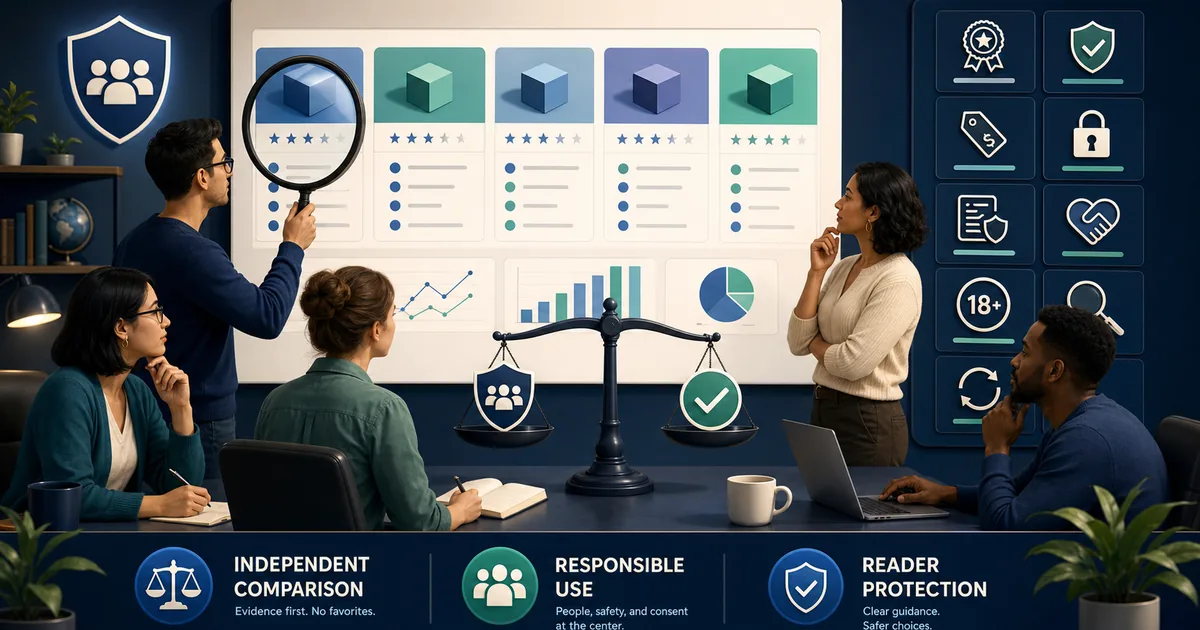
Undress Net exists to help adult readers compare AI image tools with clearer information while understanding the responsibilities that come with them. We do not provide image-generation services. Our role is to organize evidence, explain trade-offs, disclose incentives, and place responsible use beside every product decision.
Why this category needs careful reviews
AI image services change rapidly. Prices, credits, quality, privacy language, ownership, availability, and support may shift without much notice. A polished page can make different services look equally simple even when their real costs and policies vary.
Real people also face serious risks. Technical ability does not grant permission. A review that ignores consent, age, privacy, dignity, and potential harm leaves out essential criteria.
We are a review and educational website
Undress Net does not operate the third-party tools it covers, process user images for them, control their billing, or guarantee their outputs. We compare available information and publish educational guidance so readers can ask better questions before choosing or using a service.
Readers can learn more about Undress Net, our purpose, and our contact details on the About page. Questions, corrections, or concerns can be sent to support@undress-ai.net.
Independence begins with visible criteria
A score is useful only when readers understand it. We focus on quality, consistency, speed, price, credits, policy clarity, privacy, support, and responsible-use safeguards. A large feature list does not automatically create a strong recommendation.
Criteria should be consistent. Limited or untested evidence should be described honestly instead of implying laboratory precision.
What we want every comparison to answer
- What does the service claim to provide?
- Which details were observed and which came from provider statements?
- How consistent are results rather than one selected example?
- What does the plan really cost after renewals and credit limits?
- Are privacy, retention, deletion, and data-use terms understandable?
- Are adult-only, consent, and prohibited-use rules clear?
- Can users find cancellation, refund, reporting, and support routes?
- When was the information checked and what could change?
- Could an affiliate relationship influence the presentation?
- What important limitation should the reader know?
We distinguish evidence from provider claims
A provider may describe a service as private, fast, accurate, anonymous, or secure. Those statements should be attributed rather than silently converted into independent conclusions. Direct observation, public policy language, marketing claims, and editorial interpretation are different evidence types.
When independent confirmation is unavailable, responsible wording says so. We avoid absolute promises such as “completely safe,” “never stored,” or “guaranteed result” unless unusually strong and current evidence supports them.
Consistency matters alongside quality
One impressive output can hide failed attempts, artefacts, long queues, or unpredictable identity changes. Reviews should consider whether quality can be repeated under ordinary conditions and whether retries increase cost or data exposure.
Examples also need context. Readers should know whether an image is typical, selected from many attempts, supplied by a provider, edited afterward, or created under special conditions. Demonstrations must use fictional adults, properly licensed material, or images with explicit permission for the exact use.
Price means more than the headline number
A low displayed price may involve annual billing, expiring credits, premium actions, limited exports, automatic renewal, or restricted refunds. We encourage readers to compare the total charge, usable volume, renewal terms, cancellation process, and what happens to unused credits.
Plans change, and checkout information may differ by country or tax status. Readers should verify the final transaction details directly before paying. Our guide to small subscription policy details explains the checks.
Privacy is a comparison category, not fine print
Images can reveal faces, homes, workplaces, documents, location clues, device metadata, and relationships. Before uploading, users need understandable information about collection, retention, deletion, backups, human review, model training, third-party processing, and security.
A policy is not proof that every practice is flawless, but missing or contradictory information is itself relevant. We do not tell readers that a service is risk-free. We encourage data minimization, low-risk testing, account security, and avoidance of unnecessary identifying material.
Affiliate funding must be disclosed
Some links may generate a commission if a reader makes a purchase, without adding to the reader’s price. This can support the site, but it also creates an incentive that belongs in the open. A commercial relationship should never buy a score, favourable wording, or removal of justified criticism.
Our Affiliate Disclosure explains the model. Readers should see the relationship before making a commercial decision rather than discovering it in hidden legal language.
Editorial standards should be public
Our Editorial Policy describes how we approach independence, evidence, updates, affiliate relationships, corrections, AI-assisted work, and sensitive content. Publishing the standard makes our work easier to evaluate and gives readers a basis for raising concerns.
No policy eliminates human error. It creates a repeatable process and an accountable route for correction.
Corrections are part of trustworthy publishing
A provider, reader, or subject may identify an outdated price, inaccurate statement, broken link, policy change, or privacy concern. We evaluate verifiable information and correct material errors. A provider does not need to purchase advertising or affiliate access to request a factual review.
Corrections should not be used to erase legitimate editorial judgment. Likewise, a fresh date should not be added unless the underlying information was meaningfully checked.
Responsible use is not optional
Every real person must be treated as a person, not raw material. Do not upload, edit, create, save, or share intimate AI imagery of a real person without clear, informed, specific permission. A public photo, a private message, a relationship, or previous consent for another purpose is not permission for a new transformation.
Consent can be withdrawn. Permission to create does not automatically include permission to publish, forward, monetize, or store indefinitely. When consent changes, stop and remove controlled copies promptly.
There is zero tolerance for content involving minors
Never create, request, possess, or share sexualized content involving anyone under 18, including edited, generated, fictionalized, or “aged-up” material. If age is uncertain, do not use the image.
Adult-only access does not make every adult use acceptable. Consent, source rights, privacy, acceptable-use rules, and applicable law still matter.
Dignity matters even when an image is synthetic
An AI-generated image can still be used to harass, impersonate, deceive, shame, threaten, or blackmail. Harm does not disappear because pixels were generated rather than captured by a camera. Realistic synthetic media can affect reputation, safety, relationships, and emotional wellbeing.
Do not redistribute harmful imagery while criticizing or reporting it. Preserve only the evidence appropriate for a platform, payment provider, trusted adviser, or lawful authority, and protect the affected person’s privacy.
We support informed adult choice without shame
Adults may approach AI image tools for creativity, curiosity, fantasy, accessibility, confidence, or companionship. Personal needs do not make someone undeserving of clear information. Responsible guidance should be direct without humiliating the reader.
At the same time, loneliness, disability, desire, or curiosity cannot replace another person’s consent. Fictional adult material and clearly agreed uses provide boundaries that respect both personal exploration and human dignity.
Readers should verify before acting
Our Undress Net comparison homepage is a starting point, not a guarantee. Verify the current operator, price, terms, privacy policy, eligibility, availability, and cancellation process. Consider the laws where you and any depicted person live.
Use the Safety Guide and pause whenever age, consent, rights, retention, or harm remains uncertain.
The Undress Net review promise
- Explain comparison criteria instead of asking for blind trust.
- Separate observations, claims, inference, and uncertainty.
- Disclose affiliate relationships and keep them separate from scores.
- Check changing details and avoid artificial update dates.
- Correct material errors through an accessible contact route.
- Protect privacy in examples and reports.
- Place consent, adulthood, dignity, and responsible use beside product information.
- Never present a review as a guarantee of results, safety, legality, or refunds.
A comparison should leave the reader more capable
The goal is not to push every visitor toward a purchase. A useful review may help someone choose a service, postpone a decision, ask support a better question, select a lower-risk alternative, or decide not to proceed. Those are all valid outcomes.
Independent publishing earns trust through visible process rather than slogans. We will continue improving our comparisons, policies, educational guides, internal links, and correction practices as the category develops.
Our position
Undress Net supports informed adult choice, independent comparison, explicit consent, privacy, dignity, and lawful use. We do not provide AI image-generation services and do not support non-consensual intimate imagery. Technology never removes personal responsibility.