
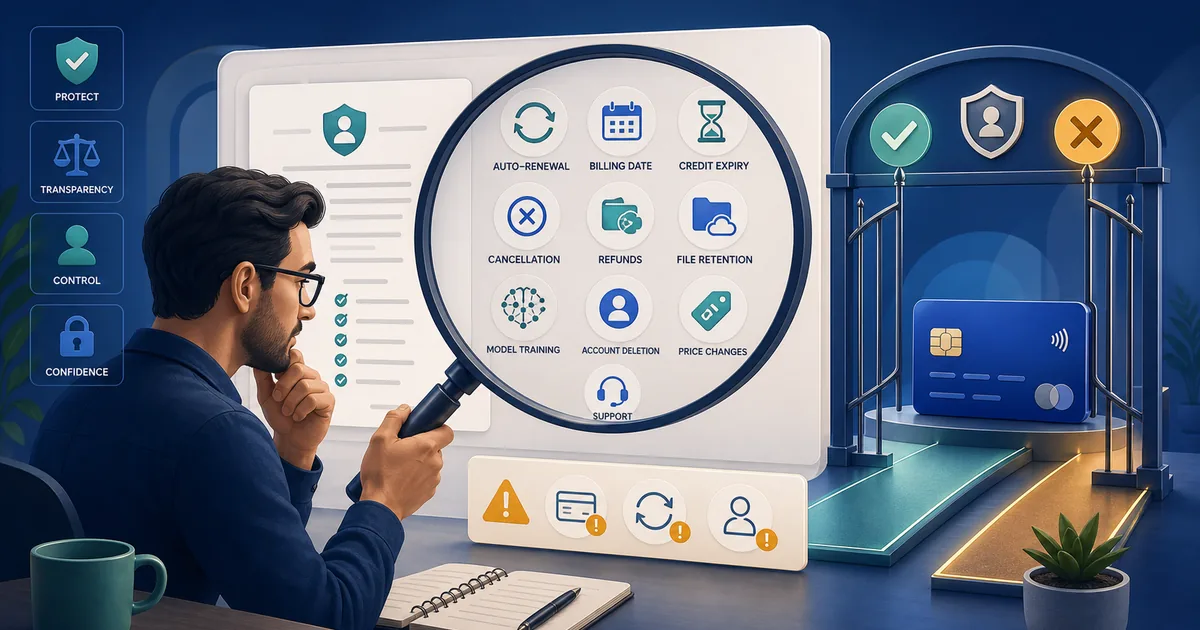
A subscription can look simple: choose a plan, enter payment details, and receive access. The important commitments are often scattered across checkout notes, pricing FAQs, policies, and account settings. Reading those details before paying helps you compare the actual agreement rather than the most attractive headline.
The displayed price is not the whole commitment
A monthly figure may be charged as one annual payment, offered only for the first period, or shown without tax. Check the billing interval, total due today, currency, and price after any introductory offer.
For a structured view of services, start with the Undress AI tool comparison, then verify current details on the provider’s checkout and policy pages. The contract shown at purchase controls the transaction.
Free trials may convert automatically
A trial can require payment information and begin charging when it ends. Note its length, conversion price, billing date, and cancellation deadline. “Cancel anytime” may mean only that future renewals can be stopped.
Set a reminder before the deadline and keep the confirmation. Time zones or an immediate start can make the practical deadline earlier than expected.
Auto-renewal changes the default
With auto-renewal, doing nothing creates another payment. Policies should explain whether renewal is monthly or annual, whether notice is sent, and how far in advance you must act. Look for any right to change the renewal price and how the company communicates that change.
A responsible purchase decision treats the renewal amount as part of today’s commitment. If the account dashboard hides the renewal date or makes cancellation unclear, that is relevant to the service evaluation.
Small details to check before paying
- Total charge today, billing currency, taxes, and conversion fees.
- Trial end date, renewal interval, and future price.
- How credits are used, whether they expire, and whether they roll over.
- Cancellation deadline, method, and confirmation process.
- Refund eligibility after use, renewal, or technical failure.
- What happens to uploads, outputs, and backups after deletion.
- Whether content may be reviewed, shared, or used for model improvement.
- Your rights in outputs and the licence granted to the provider.
- Adult-only, consent, prohibited-use, and location requirements.
- Support channel, response expectations, and dispute process.
Credits are a second price system
Credit-based plans make value depend on more than the subscription fee. One action may consume several credits, retries may count, premium options may cost more, and failed results may not be restored. A large credit number means little until the expected cost per ordinary task is clear.
Check whether unused credits expire at the end of a billing cycle, roll over with limits, or disappear when a plan is cancelled. Also ask whether purchased credit packs depend on an active subscription. Our guide to subscriptions, credits, and refunds explains how to estimate usable value.
Cancellation and account deletion are different
Cancelling usually stops future billing while leaving the account available until the paid period ends. Deleting an account may remove access but does not always cancel a payment managed by an app store or other processor. Never assume one action completes the other.
Follow the documented steps, check the subscription status, and save a dated cancellation confirmation. If billing was arranged through a third party, verify it in that payment account too. The provider’s Terms of Use should describe the controlling rules.
Refund language contains important limits
“Refund available” can be restricted by time, usage, location, payment method, or reason. A policy may exclude renewals, partially used credit packs, digital services already delivered, or accounts that violated usage rules. Technical dissatisfaction may be handled differently from duplicate billing.
Read the eligibility conditions before purchase rather than after a problem. Where consumer law provides additional rights, a policy cannot necessarily remove them; however, legal rights differ by jurisdiction. Keep receipts, screenshots, error details, and support messages if a billing issue occurs.
Deletion promises need a timeline and scope
A statement that files “can be deleted” is incomplete without explaining when, from which systems, and what exceptions remain. Uploads, generated outputs, account records, logs, fraud-prevention information, and backups may follow different schedules.
Look for default retention periods, manual deletion controls, backup expiry, legal exceptions, and a contact route. The site’s Privacy Policy should also identify the operator, data categories, purposes, recipients, security approach, and available privacy rights.
Model training and human review deserve explicit answers
Some services may use submitted content to improve systems, moderate abuse, troubleshoot errors, or evaluate quality. These purposes are not interchangeable. Check whether use is automatic or optional, whether an opt-out exists, and whether the choice applies to future uploads only.
Human access should be limited, justified, and protected. Sensitive or identifying images require particular caution. Even a strong policy cannot make a non-consensual upload acceptable: use only lawful material involving confirmed adults who have clearly agreed to the exact use.
Third parties can be part of the service
Payment processors, cloud hosts, analytics providers, moderation vendors, and support platforms may receive limited data. A provider should explain relevant categories and purposes. “We do not sell data” does not answer whether data is shared for processing, security, advertising, or legal compliance.
Location matters as well. International transfers can place information under different legal systems, and regional availability may affect features, prices, refunds, and rights.
Ownership and licence are not the same
A policy may say that you retain ownership while also granting the service a licence to host, process, reproduce, moderate, or display content. The scope, purpose, duration, sublicensing rights, and end point of that licence matter.
Also check what rights the provider gives you in outputs and whether commercial use is permitted. AI output rights can be uncertain and depend on law, source material, and third-party rights. A subscription should never be treated as permission to use another real person’s likeness.
Acceptable-use rules can affect access and refunds
Adult-only and responsible-use restrictions are not decorative. A service may suspend an account, preserve evidence, report serious abuse, or deny a refund when rules are violated. Review the consent standard, prohibited content, age requirements, and regional restrictions before uploading anything.
If a person’s age is uncertain, do not use the image. Never create, request, possess, or share sexualized material involving anyone under 18. Do not use image tools for harassment, impersonation, blackmail, deception, or non-consensual intimate content.
Plans and policies can change
Providers may update features, credit costs, prices, limits, or policies. Check how notice is delivered, when a change takes effect, and whether you can cancel before it applies. An undated page makes comparison harder.
Save the checkout summary, plan name, renewal price, and policy date as a reliable reference.
Support details matter before there is a problem
A contact form is more useful when the operator, expected response route, and complaint process are clear. Check whether billing, privacy, safety, and removal requests have appropriate channels. Immediate help should not be promised unless it is genuinely available.
For a practical reading method, see how to read terms before starting a paid plan. It is easier to judge a service calmly before payment than while trying to resolve a charge or remove a file.
A five-minute decision routine
- Write down the total amount due today and the next renewal amount.
- Estimate how many ordinary tasks the included credits realistically cover.
- Find the cancellation, refund, retention, and deletion rules.
- Check content use, human review, third-party sharing, and licensing.
- Confirm adult-only, consent, location, and acceptable-use requirements.
- Locate a working support route and save the purchase confirmation.
Small print should not require blind trust
Not every detailed policy is fair, and not every short policy is harmful. The test is whether a reasonable adult can understand the commitment before paying and exercise important choices afterward. Clear summaries should lead to complete terms, not replace or contradict them.
When an essential answer is missing, ask support before subscribing or choose a clearer alternative. Uncertainty about renewal, deletion, consent, or data use is itself useful comparison information.
Our position
Undress Net is an independent review and educational website, not an AI image-generation service. We believe subscriptions should be judged by real cost, clear policies, privacy controls, responsible-use safeguards, and accessible support. No paid plan removes the user’s duty to obtain explicit consent, protect dignity, confirm adulthood, and follow applicable law.