
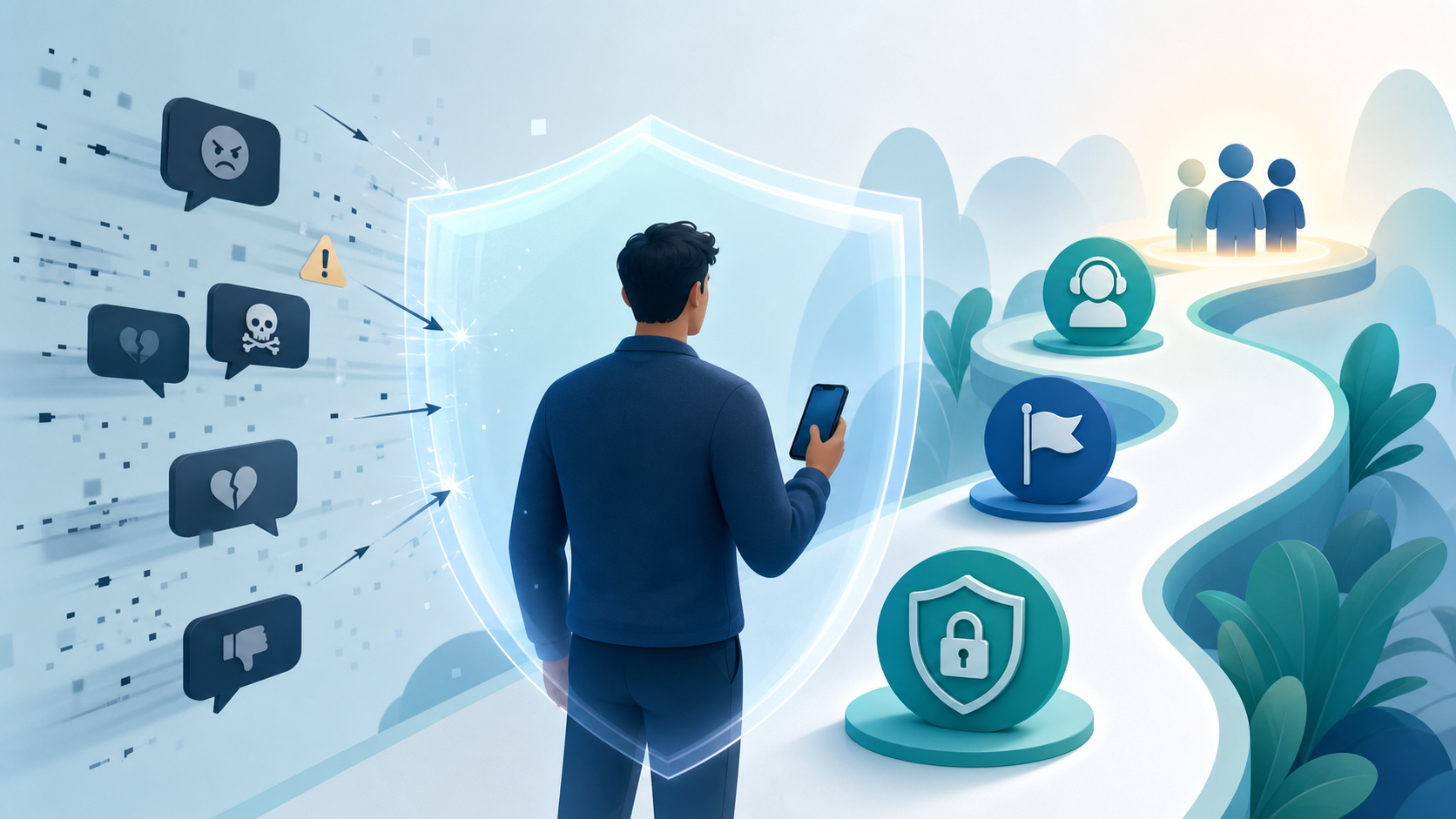
If someone threatens to publish an intimate, edited, or AI-generated image unless you send money, more images, account access, or another favour, the responsibility belongs to the person making the threat. You do not have to manage the situation alone, and you do not need to obey an artificial deadline.
If there is immediate danger
If you believe anyone is in immediate physical danger, contact local emergency services. If a person may be under 18, do not download or redistribute sexualized material; use the platform’s child-safety reporting process and seek qualified local help.
Recognize what is happening
Online coercion may begin with a friendly conversation, a romantic approach, an image request, or access to an existing photograph. The person may then threaten exposure, impersonation, humiliation, contact with family or employers, or continued harassment. They may claim that payment is the only way to make the problem disappear.
This can be blackmail, extortion, sextortion, harassment, impersonation, or non-consensual intimate-image abuse, depending on the facts and local law. The label matters less in the first few minutes than recognizing the core tactic: fear is being used to force a decision that you would not freely make.
Pause before responding
Do not let a countdown, repeated call, or threatening message determine your next move. Put the device down briefly if it is safe to do so. Take a breath, move near someone you trust, and avoid sending an impulsive reply. A short pause can prevent additional disclosure and give you time to preserve useful information.
Do not argue about whether the image is real, challenge the person to publish it, insult them, or make counter-threats. Escalation can increase risk and may complicate reporting. You are not required to persuade the person that their behaviour is wrong.
A practical first-response checklist
- Move to a safe place and tell a trusted person what is happening.
- Do not send money, more images, passwords, verification codes, or identity documents.
- Preserve relevant messages, usernames, profile links, payment requests, dates, and times.
- Secure your email, social accounts, cloud storage, and recovery methods.
- Report the account and content through the relevant platform route.
- Block or restrict contact after preserving what you need.
- Seek local professional or law-enforcement guidance where appropriate.
- Review public information that could be used to contact people around you.
Do not assume payment will end the threat
Paying does not guarantee deletion. A person using coercion may ask for more money, invent new deadlines, or sell the information to someone else. Sending another image or performing another task can create additional material for pressure. If money has already been sent, stop further payments and contact the payment provider promptly to ask what fraud or transfer-reporting options are available.
Do not feel ashamed if you already complied. Manipulation is designed to overwhelm judgment. The useful question now is not why you reacted under pressure, but what step can reduce further harm.
Preserve evidence without spreading the content
Record the account name, profile URL, phone number or email address, dates, message text, threats, payment details, and report confirmation numbers. Screenshots of the conversation may help, but avoid creating unnecessary copies of a sensitive image. Do not forward the material to friends simply to prove what happened.
Keep evidence in a restricted location and follow instructions from the platform, a lawyer, a support organization, or relevant authority. If a minor may be involved, do not save or share sexualized imagery. Preserve non-explicit contextual information instead and use official reporting channels.
Protect your accounts immediately
Begin with the email account used for password recovery. Change reused or exposed passwords from a trusted device, use a unique password for each important account, enable multi-factor authentication, and save recovery codes securely. Review active sessions, connected applications, forwarding rules, recovery addresses, and recent security alerts.
Then secure social media, messaging, cloud photo storage, mobile accounts, and payment services. A password change may not end an already active session, so use the option to sign out other devices when available. Tell close contacts not to trust unusual messages, payment requests, or new accounts using your name.
Reduce the information available to the person
Review who can see your followers, friend list, workplace, school, relatives, tagged images, location, and contact information. Temporarily limit messages and tags from unknown accounts. Ask trusted contacts not to engage with the threatening person or share information about you.
Changing privacy settings cannot guarantee that saved material disappears, but it can reduce new avenues for pressure. Our Safety Guide explains additional steps for public photographs, privacy settings, minors, and responsible image use.
Report through the right channel
Platforms may offer separate forms for harassment, impersonation, blackmail, privacy violations, non-consensual intimate imagery, or child safety. Choose the most specific category available and include clear facts: what was threatened, which account was involved, when it happened, and where the content or message appears.
Save the report reference and check whether the service offers account blocking, image-matching, removal, or appeal tools. If one report is rejected, review the reason and use an appeal or a more accurate category. For material or links found on this website, you can report a concern confidentially. Undress Net cannot remove material hosted by an unrelated platform, but we can review content under our control.
Ask a trusted person to stay with you
Coercion becomes more powerful in isolation. Tell a friend, family member, counsellor, safeguarding professional, or other trusted adult. They can help record facts, secure accounts, make reports, and prevent rushed decisions. Ask them not to contact the person, circulate the image, or post publicly without your permission.
If you are supporting someone else, listen without blame. Avoid questions that sound like an interrogation. Say clearly that the threat is not their fault, that they do not have to face it alone, and that you will respect their choices wherever safety and the law allow.
Plan for possible publication without surrendering control
A threat may be false, but it is reasonable to prepare. Tell a small number of trusted contacts that they may receive harmful or fabricated material and should not open, forward, reply, or pay. Ask them to record the sender and report the message. You do not need to describe the image in detail.
If content appears online, save the URL, account name, date, and visible context before reporting it. Search results and reposts may require separate removal requests. Avoid making a broad public announcement unless it supports a considered strategy; publicity can unintentionally increase distribution.
Be careful with recovery offers
After a public report, supposed investigators or removal specialists may promise guaranteed deletion for an upfront fee. Verify identities, fees, scope, privacy practices, and realistic limitations. Do not give a stranger remote access to your device or new copies of sensitive material.
No legitimate helper should shame you, demand secrecy, or pressure you to pay immediately. Independent information on the Undress Net homepage can help readers compare privacy, transparency, and responsible-use standards before trusting an online service.
When to seek professional help
Consider contacting local law enforcement, a lawyer, a victim-support service, a school or workplace safeguarding lead, or a specialist helpline when threats continue, money is demanded, accounts are compromised, content is distributed, or anyone faces physical danger. Applicable options vary by country, so use qualified local guidance rather than assuming one legal process works everywhere.
Threats can cause panic, sleeplessness, shame, or thoughts of self-harm. If you or someone you know may act on such thoughts, contact local emergency or crisis support now and stay with a trusted person. Emotional safety is part of the response, not an afterthought.
What not to do
- Do not send more money, images, credentials, codes, or personal documents.
- Do not hire an unverified person who promises guaranteed removal.
- Do not publicly accuse a named individual without reliable evidence.
- Do not organize retaliation, hacking, doxxing, or harassment.
- Do not forward sensitive content to collect opinions about whether it is real.
- Do not blame yourself or the person depicted for another person’s coercion.
Our position
Undress Net is an independent review and educational website, not an AI image-generation service. We do not support blackmail, harassment, impersonation, non-consensual intimate imagery, or sexualized content involving minors. Threats should be met with safety, evidence preservation, account protection, trusted support, and appropriate reporting—never shame.