
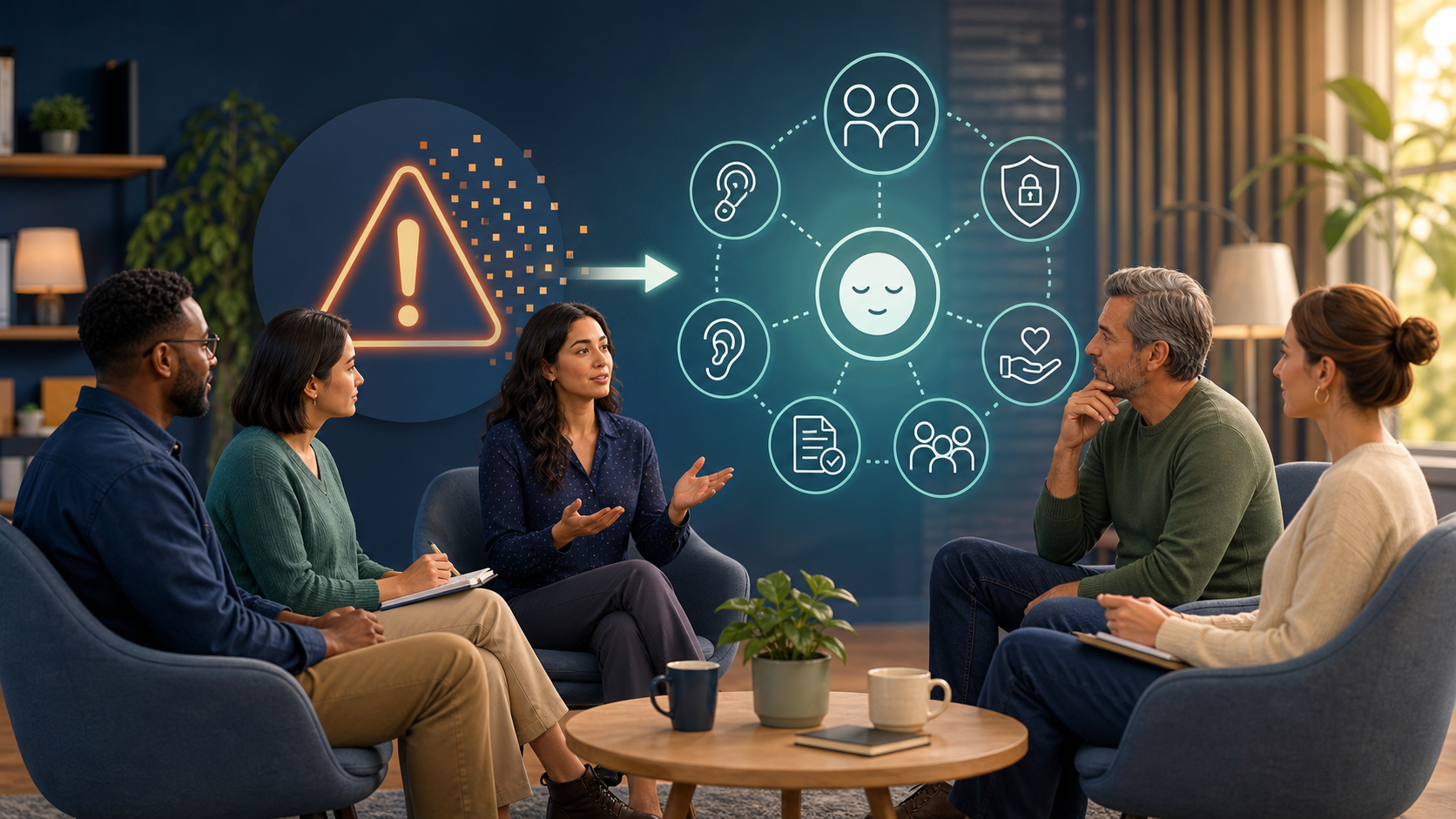
Conversations about AI-edited images can easily become sensational. A frightening example spreads faster than a careful explanation, and a person whose image was misused may be treated as a lesson rather than a human being. Better communication names the risk precisely, keeps responsibility with the person causing harm, explains realistic limits, and gives the audience something useful to do.
Start with the purpose of the conversation
Are you warning a community, supporting an affected person, teaching students, writing policy, reporting news, or helping someone choose a service? The purpose determines what detail is necessary and who needs to hear it. A useful discussion is designed around an outcome, not attention.
If the goal can be achieved without naming a person, showing a sensitive image, or repeating humiliating details, leave them out. Privacy is not an obstacle to education; it is part of responsible education.
Name the risk accurately
“AI danger” is too broad to guide action. Say whether the issue involves non-consensual intimate imagery, impersonation, blackmail, misleading advertising, account compromise, privacy, false context, uncertain consent, or sexualized content involving a minor. Different risks require different responses.
Use neutral descriptions such as “AI-edited image,” “synthetic media,” or “reported non-consensual image” when accurate. Avoid language that sexualizes the subject, turns the material into a spectacle, or makes an unverified technical claim.
A five-part communication framework
- Define: state the specific risk in plain language.
- Locate responsibility: identify the harmful action without blaming the person depicted.
- Calibrate: explain likelihood, uncertainty, and limits honestly.
- Act: provide concrete privacy, security, reporting, or support steps.
- Support: make it safe for someone to ask for help without punishment or shame.
Do not blame the person depicted
A public selfie, private message, relationship, old photograph, or mistaken decision does not cause another person’s abuse. Questions such as “Why did they post that?” shift attention away from the person who created, threatened, or distributed the harmful material.
People deserve support even when their privacy habits were imperfect. Prevention advice can be discussed later without making assistance conditional on having followed every rule.
Separate risk from inevitability
AI editing can create convincing harmful material, but that does not mean every public image will be misused or that protection is impossible. Claims that “nothing is safe anymore” may increase helplessness without improving decisions.
Explain what can reduce risk: limit identifying details, review account settings, use unique passwords and multi-factor authentication, question suspicious requests, obtain explicit consent, avoid unnecessary uploads, understand retention, and know reporting routes. These measures do not guarantee safety, but they are meaningful.
Avoid false reassurance
Calm communication is not the same as minimizing harm. A synthetic image can affect reputation, relationships, employment, safety, and emotional wellbeing even when viewers know it is fake. Removal can be difficult after redistribution, and threats may require urgent support.
Say what is known and what remains uncertain. Do not promise that a report, payment, detector, watermark, or deletion request will solve every case. Honest limits support better planning.
Do not use harmful examples
A warning post does not need to reproduce the image it condemns. Screenshots, blurred copies, detailed descriptions, and links may still identify the subject or direct attention to the material. Use fictional scenarios, diagrams, or non-identifying summaries.
Never download, possess, or redistribute suspected sexualized content involving anyone under 18. Use official child-safety reporting channels. Do not post the material to prove that the problem exists.
Keep technical claims proportionate
Do not announce that an image is authentic or AI-generated solely because of a strange hand, reflection, detector score, or metadata field. Visual anomalies and automated analysis can be useful clues, but both have limits.
Distinguish confirmed facts, reported information, expert assessment, and inference. Explain the source of each claim and correct errors visibly when better evidence appears.
Use statistics carefully
A large number can create urgency while hiding how it was measured. Check the population, date, definition, sample, source, and whether reports represent incidents, files, searches, accounts, or affected people. Do not combine incompatible measures.
When reliable prevalence data is unavailable, say so. Anecdotes show that harm can occur, but they do not establish how often it occurs. Avoid turning one person’s experience into a universal prediction.
Offer actions at the right level
Individuals can strengthen accounts, reduce identifying details, preserve appropriate evidence, report content, and seek trusted support. Families can create calm disclosure plans. Platforms can improve consent rules, moderation, removal, and appeals. Publishers can disclose AI editing and preserve context. Policymakers and professionals can address legal and support gaps.
Do not place the entire burden on potential targets. Privacy settings cannot replace accountability for creators, distributors, services, and institutions.
Replace panic language with useful language
- Instead of “Anyone can destroy your life,” explain the specific misuse and available response.
- Instead of “Never post a photo,” discuss audience, identifying details, settings, and consent.
- Instead of “You should have known,” say the harmful behaviour is not the subject’s fault.
- Instead of “This detector proves it,” describe the score as one limited signal.
- Instead of “There is nothing you can do,” provide a prioritized action list.
- Instead of “Share this warning everywhere,” avoid redistributing sensitive content.
When speaking with a person affected
Listen before giving instructions. Thank them for telling you, check immediate safety, and ask what outcome they want. Do not demand the image, contact the suspected creator publicly, or make decisions on the person’s behalf unless safety or legal duties require action.
Explain options without pressure: account security, platform reporting, removal requests, trusted support, qualified local advice, and emergency help where needed. Allow time to decide when there is no immediate danger.
When speaking with young people
Use age-appropriate language and clear adult-only boundaries. Tell them they can seek help even after breaking a household rule or responding to pressure. The first reaction should focus on safety, not confiscation or blame.
Adults should not promise absolute secrecy when immediate danger or safeguarding duties apply. Explain who may need to know, why, and how unnecessary exposure will be avoided.
When moderating a public discussion
Remove requests for links, copies, names, identifying clues, and explicit detail. Prohibit victim-blaming, sexual commentary, jokes, threats, doxxing, and unsupported accusations. Provide a private reporting route and state what the moderators can actually do.
Closing a harmful discussion is not censorship of education. It prevents the educational frame from becoming another route for exposure, gossip, or harassment.
When there is immediate risk
If anyone faces immediate physical danger, contact local emergency services. Threats, blackmail, account compromise, ongoing distribution, and severe emotional distress may require qualified local support. If someone may act on thoughts of self-harm, stay with them and seek emergency or crisis assistance now.
For material or links on this website, use Contact / Report a Concern. Undress Net cannot remove content hosted by unrelated services, but we can review what is under our control.
Connect education to practical guidance
Our practical guidance on consent and privacy covers adult-only use, public photos, parents, threats, reporting, and responsible decisions. The Undress Net homepage compares services while emphasizing that technology never removes personal responsibility.
Educational content should leave readers more capable, not merely more afraid. The standard is simple: accurate information, respect for the affected person, proportionate caution, and a clear next step.
Our position
Undress Net is an independent review and educational website, not an AI image-generation service. We oppose non-consensual intimate imagery, harassment, blackmail, impersonation, and sexualized content involving minors. Discuss risks honestly without shame, panic, needless exposure, or false certainty.