
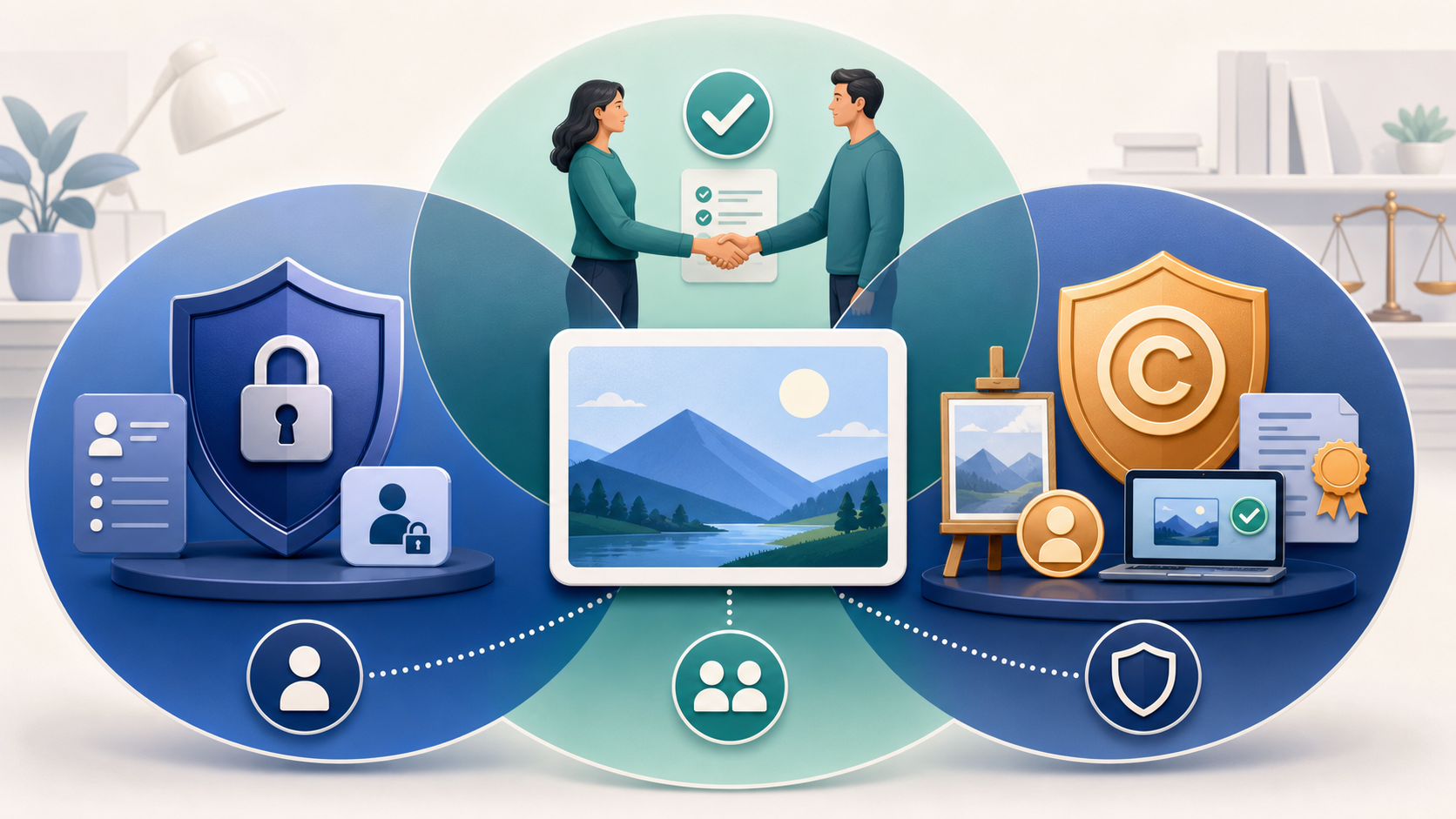
A person may own the copyright in a photograph without having unlimited permission to use the identity of someone pictured. A subject may consent to one publication without transferring copyright. A service may have a licence to process an image while still needing to respect privacy, data-protection, contractual, or personality rights. Understanding the difference prevents one permission from being treated as permission for everything.
Start with three different questions
Privacy asks how information about a person is collected, used, exposed, stored, and shared. Consent asks what a person freely agreed to in a particular situation. Copyright asks who controls specified uses of an original creative work.
The answers can overlap, but they do not merge. An image can be lawfully licensed from its photographer and still be used in a way that violates a subject’s privacy or agreed boundary. A subject can approve an edit while the editor still lacks permission from the copyright owner.
A quick comparison
- Privacy: protects personal information, private life, dignity, and control under applicable rules.
- Consent: records a person’s agreement to a specific use, purpose, audience, and set of conditions.
- Copyright: protects qualifying creative expression and gives the rights holder control over certain uses.
- Contract or licence: may define permissions between parties but cannot automatically erase rights held by others.
- Platform rules: can impose stricter limits than the minimum required by law.
What privacy covers
Privacy is broader than secrecy. A photograph may reveal identity, appearance, location, relationships, health, beliefs, home, workplace, or other personal context. Under some data-protection regimes, an image of an identifiable person can be personal data even when it was taken in public.
Organizations may need a lawful reason to process personal data, explain the purpose, minimize collection, protect the information, limit retention, and respect applicable rights. Consent can be one legal basis in some systems, but it is not the only possible basis and should not be claimed when another basis is actually being used.
Privacy depends on context
Expectations can change with location, relationship, subject matter, audience, and purpose. A crowd scene, identification photograph, medical image, private message, news photograph, and intimate portrait do not present the same risk. A public post can still contain personal data or be reused in a harmful context.
Local law may recognize privacy, data protection, confidentiality, publicity, image, personality, or related rights differently. Do not assume that a rule from one country applies everywhere.
What consent means
Consent is permission from a person with the capacity and information needed to decide. In responsible image use it should be freely given, informed, specific, ongoing, and available for withdrawal. Pressure, fear, deception, silence, or dependence can make apparent agreement unreliable.
Consent should identify the image, tool or process, purpose, audience, storage, sharing, and expected result. Permission to take a photo does not automatically include permission to upload it to an AI service. Permission for a private edit does not include public distribution.
Consent is not ownership
A model or subject may consent to being photographed without owning the resulting copyright. A photographer may own copyright while lacking permission to publish the image in every context. A written release may grant specified uses without transferring the underlying creative rights.
Always ask two separate questions: do we have rights in the work, and do we have appropriate permission involving the person? One answer cannot safely substitute for the other.
Withdrawal has limits that should be explained
A person can withdraw consent for future activity where consent is the relevant basis, but withdrawal may not automatically erase every earlier lawful use, recipient copy, legal record, or independent right. The practical result depends on the agreement and applicable law.
Responsible projects should explain these limits before use, stop new processing where required, remove controlled copies when appropriate, and avoid promising complete internet-wide deletion that cannot be delivered.
What copyright covers
Copyright commonly protects qualifying creative works such as photographs, illustrations, and other visual media. The rights holder may control reproduction, distribution, adaptation, public display, or other uses defined by local law. Ownership may begin with an author but can be transferred, licensed, or affected by employment and contract rules.
Copyright generally protects expression rather than the underlying idea. Protection, exceptions, duration, registration, and ownership vary by jurisdiction. The World Intellectual Property Organization’s copyright FAQ provides a useful international overview, but national advice may still be necessary.
Public access does not remove copyright
A photograph being visible on a website does not place it in the public domain. Downloading, editing, reposting, or using it as an AI input may implicate rights even when the file is easy to access. A credit is not a substitute for permission.
Check the licence, scope, territory, duration, attribution, commercial-use conditions, modification rights, and sublicensing terms. Keep records of where the licence came from and which version applied.
Copyright exceptions are not universal
Some legal systems recognize exceptions or limitations for purposes such as quotation, criticism, news, education, parody, research, or fair use. These rules are fact-specific and differ substantially. A commercial AI transformation is not automatically protected because it changes the original.
Do not rely on a broad online summary for a high-stakes use. Seek qualified advice in the relevant jurisdiction when ownership, licensing, exceptions, or potential infringement is uncertain.
AI adds another layer of uncertainty
An AI workflow may involve source images, prompts, model terms, generated output, editing, and publication. Rights and obligations can arise at each step. A service’s terms may grant it a licence to process uploads without confirming that the user had permission to provide them.
The copyright status of AI-generated output can depend on national law, human creative contribution, contracts, and the facts. A provider saying that users “own outputs” cannot guarantee that copyright exists, that the output is unique, or that it does not affect another person’s rights.
Before using an image in an AI workflow
- Identify the copyright owner and any licence conditions.
- Identify every real person and whether the planned use affects privacy or personality rights.
- Obtain explicit, specific permission when consent is required or ethically necessary.
- Check the service’s upload, training, retention, sharing, and deletion terms.
- Confirm that all depicted people are adults for adult-content contexts.
- Define the purpose, audience, storage period, and withdrawal process.
- Keep records without retaining unnecessary sensitive material.
- Recheck rights before changing the edit, audience, or commercial purpose.
Examples show how the rights overlap
Your own selfie: you control your decision to use it, but another person may own the copyright if they took the photo. The service will also process personal information about you.
A licensed stock photograph: the licence may permit certain edits, yet model releases and sensitive-use restrictions may limit how a depicted person can be presented.
A friend’s public post: public visibility provides neither automatic copyright permission nor consent for an AI transformation.
A commissioned portrait: payment does not by itself answer ownership, publication, model permission, or reuse. Check the agreement.
Minors require a firm boundary
Never create, request, possess, or share sexualized content involving anyone under 18, including edited, generated, fictionalized, or “aged-up” material. Copyright ownership, parental permission, or public availability cannot make that use acceptable.
If age is uncertain, do not proceed. Do not download or redistribute suspected child sexual-abuse material; use official child-safety reporting channels.
How Undress Net handles these topics
Our Privacy Policy explains how this website handles information. The DMCA / Copyright page provides a route for copyright notices involving content under our control. Applicable procedures may differ outside the United States.
The Undress Net homepage compares adult-only services while emphasizing consent, privacy, and responsible use. A review does not grant image rights or provide legal approval for a particular use.
Use the highest relevant standard
A legal permission may still allow conduct that is disrespectful, misleading, or inconsistent with platform rules. An ethical agreement may still require a valid licence. When several protections apply, satisfy each one rather than choosing the easiest.
If you are unsure about privacy law, consent, ownership, licensing, or removal rights, pause the use and obtain qualified advice. The cost of clarification is usually smaller than the harm caused by assuming one permission covers everything.
Important legal note
This article provides general educational information and is not legal advice. Privacy, data protection, consent, copyright, image rights, exceptions, and remedies vary by jurisdiction and facts. Consult a qualified professional for advice about a specific situation.