
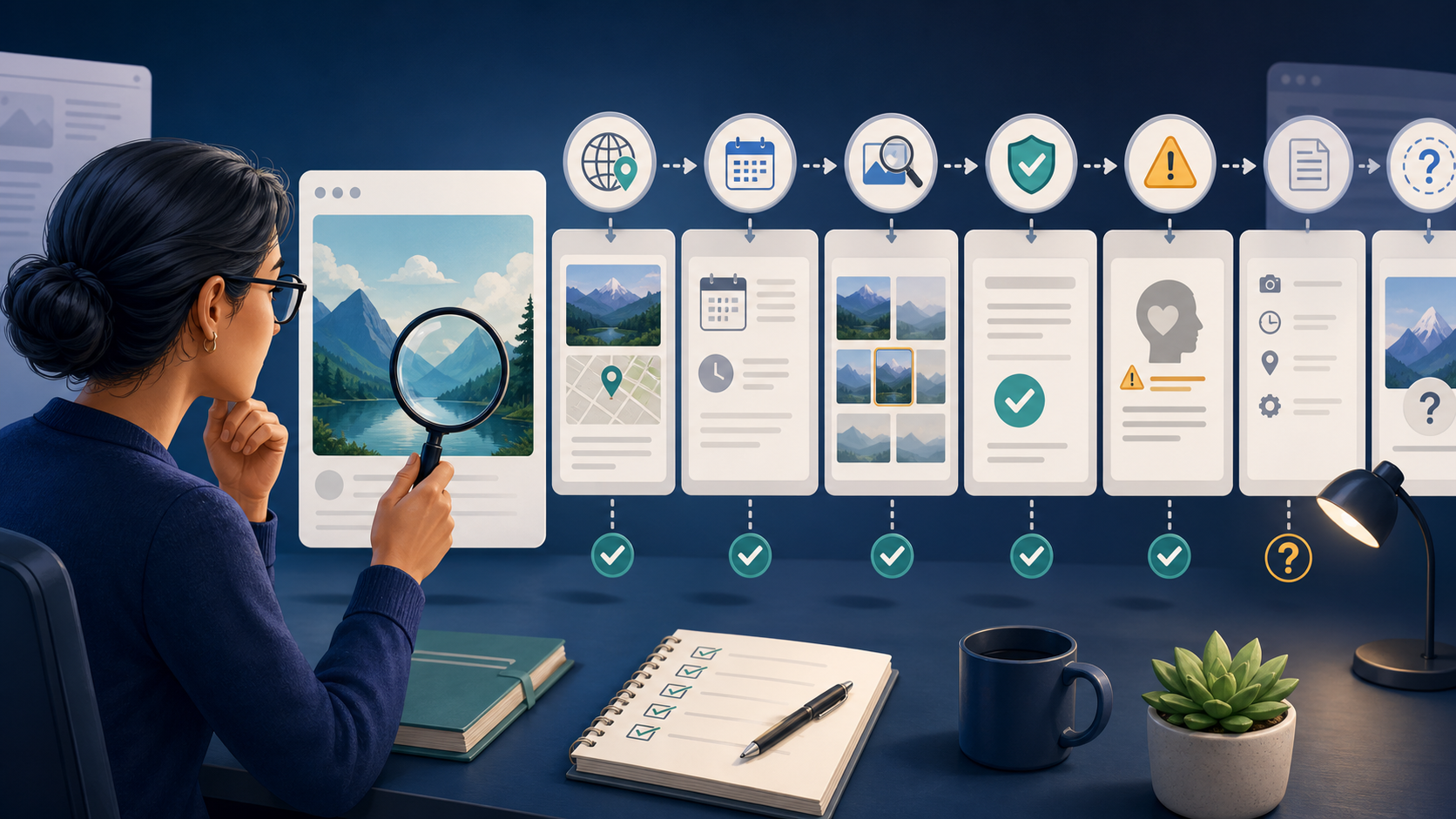
AI image literacy is the ability to evaluate a visual claim without treating realistic appearance as proof or assuming that every unusual image is fake. The skill begins with a pause. Before you like, forward, accuse, purchase, or panic, identify what the image is asking you to believe and what evidence would actually support that conclusion.
Question 1: What is the exact claim?
An image rarely speaks by itself. A caption may claim that it shows a particular person, place, date, event, product result, or private act. Write that claim in a simple sentence. This prevents the emotional impact of the visual from replacing the question you need to verify.
Different claims require different evidence. A picture may show that an object exists without proving who owns it, when it was photographed, or why it was present. A realistic portrait does not establish that the depicted person performed an action or approved the image.
Question 2: Who published it first?
Look beyond the account that placed the image in your feed. Is it the creator, a witness, an organization, a news outlet, an anonymous reposting account, or a screenshot of an unknown page? Search for the earliest credible version and examine what that source actually says.
A familiar username is not enough. Accounts can be copied, compromised, or presented through a cropped screenshot. Check the profile address, history, verification information where meaningful, and whether the content appears on the organization’s official website or another controlled channel.
Question 3: Can you find the original context?
Open the full post, article, or gallery rather than relying on a crop. Read the surrounding text. Look for the date, location, photographer or creator credit, disclosure, corrections, and links to supporting material. A screenshot can omit a satire label, AI notice, old date, or reply that changes the meaning.
If only a low-quality copy circulates, that is a reason to reduce confidence. Repeated reposting may make an image popular without making its origin clear.
The 30-second pause
- Name the exact claim.
- Check the account and date.
- Open the original context.
- Notice whether the post demands immediate emotion or action.
- Do not redistribute a sensitive image while checking it.
- If the claim matters and the evidence is weak, stop and investigate further.
Question 4: Is the date correct?
Old photographs are regularly presented as current. Check the publication date, comments, archived versions, weather, seasonal details, event schedules, signs, clothing, and known changes to the location. A correct image with a false date can produce a completely false conclusion.
Also distinguish the upload date from the creation date. A file published today may have been captured or generated years earlier. If the original date cannot be established, describe that uncertainty rather than filling the gap with assumption.
Question 5: Does the location match?
Compare landmarks, terrain, road markings, language, architecture, shadows, and weather with reliable references. Mirrored images, crops, compositing, and generic backgrounds can mislead. Do not publicly identify a private home, school, workplace, or vulnerable person merely to solve the puzzle; verification should not become doxxing.
Question 6: What does reverse image search reveal?
A reverse image search may find earlier copies, different captions, higher-resolution versions, stock-photo pages, or the original creator. Try more than one crop when practical, because a repost may add borders, text, or other elements that interfere with matching.
No result does not prove that an image is new or authentic. Search indexes are incomplete, private content may not be available, and AI-generated files may have no earlier public copy. Treat reverse search as a useful route to evidence, not a certification tool.
Question 7: Is there independent confirmation?
Look for sources that did not simply copy the same post. Independent reporting, another camera angle, official records, a direct statement, event footage, or a credible witness can provide corroboration. Ten accounts repeating one unsupported claim are still one source.
Consider whether the publisher has access to the information and a record of correcting errors. A source can be biased and still provide verifiable evidence; a source can appear neutral and provide none. Focus on the support for this claim.
Question 8: Are important edits disclosed?
Look for a clear statement about generation, compositing, background replacement, face alteration, object removal, or illustration. A label such as “enhanced” may not explain a material change. The question is whether the edit affects identity, action, location, timing, or another fact that matters to the audience.
Disclosure does not automatically make a use ethical. A labelled image can still violate consent, privacy, copyright, or human dignity. It simply helps the audience understand what kind of visual they are seeing.
Question 9: Do visible details justify suspicion?
Inconsistent reflections, lighting, perspective, repeated textures, object boundaries, hands, text, or background geometry can justify a closer look. But visual anomalies are not proof. Compression, panorama stitching, low light, filters, motion, and ordinary editing can also create strange results.
AI systems improve and vary, so a fixed checklist of “tells” becomes outdated. Start with source and context before spending too much confidence on a single pixel-level clue.
Question 10: What do metadata and provenance show?
Metadata may contain a timestamp, device, location, software history, or creator information. Provenance systems may record capture and editing steps. These signals can strengthen an assessment, but metadata may be removed or altered and provenance cannot prove every caption or real-world event. Use them alongside other evidence.
Question 11: Are you relying on an AI detector?
Detection tools may produce false positives and false negatives, and results can change after resizing, compression, screenshots, or editing. Treat a score as one signal. If stakes are high, record the tool, version, file, and result, then seek additional evidence. Never accuse a person based only on one automated score.
Question 12: What emotion is the post trying to trigger?
Urgent language, outrage, fear, disgust, desire, and a feeling of privileged access can reduce careful judgment. A post may tell you to share before deletion, act before “they” hide it, or prove loyalty by forwarding it. Emotional intensity is a reason to slow down.
Ask who benefits if you react immediately. Advertising, scams, harassment, political manipulation, gossip, and blackmail all use pressure differently, but each becomes less effective when the audience pauses.
Confidence should match evidence
- Confirmed: strong source records and independent evidence support the claim.
- Likely: several signals agree, but an important gap remains.
- Unclear: available evidence cannot resolve the claim.
- Misleading context: the image may be real, but the caption, date, location, or implication is unsupported.
- Manipulated or generated: reliable evidence supports material alteration, with the scope explained.
Question 13: Could verification itself cause harm?
Do not repost an intimate or humiliating image to ask whether it is real. Do not name a possible subject, expose a private location, or invite followers to investigate. Every new copy can increase harm even when accompanied by a warning.
For suspected sexualized content involving a minor, do not download, possess, or redistribute it. Use official child-safety reporting routes. Our Safety Guide provides practical guidance on privacy, consent, reporting, and adult-only boundaries.
Question 14: What should you do if uncertainty remains?
You do not have to reach a verdict. Do not share the image as fact. State what remains unverified and wait for better evidence. If a real person is affected, prioritize privacy and dignity: do not attach sensitive material or pressure them to respond publicly.
Apply the same standards to reviews
Visual examples in product reviews can also mislead when the test conditions, selection process, date, or provider claim are unclear. A review should distinguish direct observation from marketing, explain relevant criteria, and acknowledge what was not tested.
Our independent AI tool reviews compare current information while our editorial and review standards explain verification, corrections, affiliate disclosure, and responsible content. No screenshot or score should replace checking current terms before making a decision.
Our position
Undress Net is an independent review and educational website, not an AI image-generation service. Strong image literacy combines healthy skepticism with evidence, context, privacy, consent, and humility. Do not believe or reject an image solely because it looks realistic or strange; test the claim and communicate uncertainty honestly.